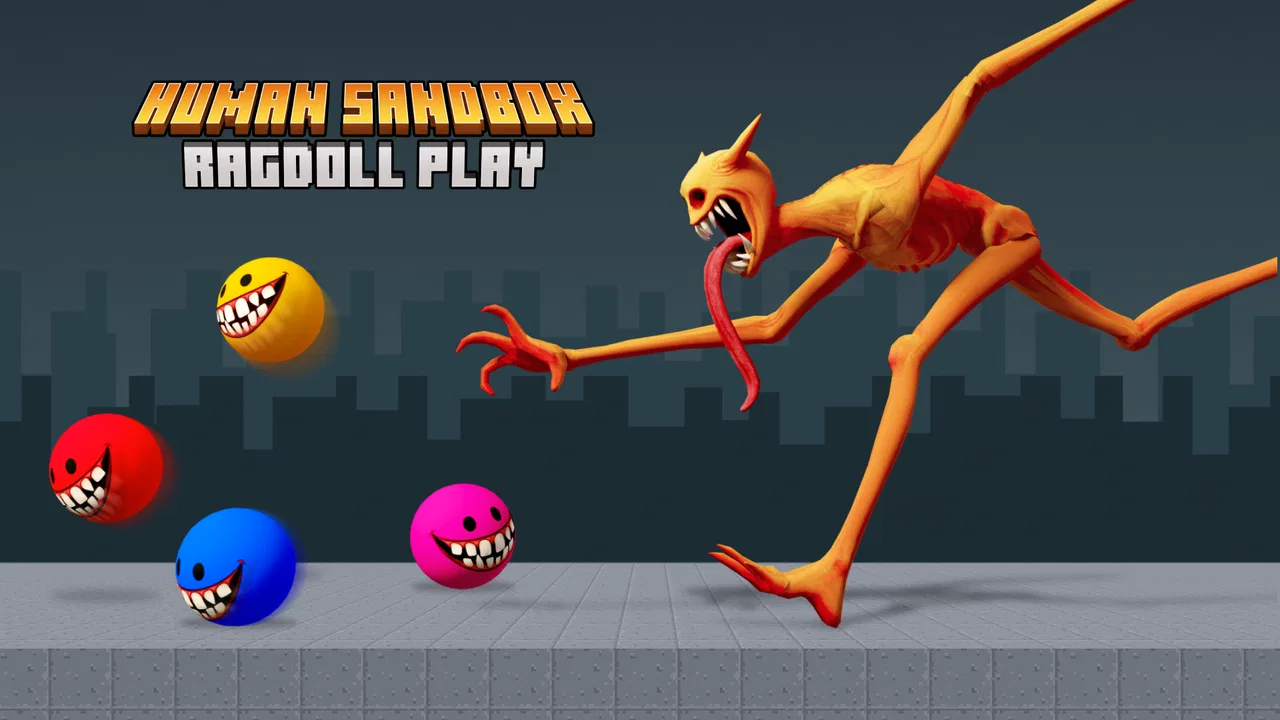
Human Sandbox: Ragdoll Play
- 4.6
- Rating
- 5.00M
- Installs
- Free
- Price

 Analysis by App-foxy
I spent time with Human Sandbox: Ragdoll Play as a casual physics playground rather than as a conventional mission-based game. That distinction matters immediately: the appeal is in arranging a scene, releasing the characters, and watching the simulation react. It is a free Android simulation game from GrassBlock Studio, aimed at Teen players, and its simple premise makes it easy to understand before the first experiment. I found it most enjoyable when I treated each session as a small creative exercise instead of expecting a campaign, a story, or a clear win condition.
The game has attracted a 4.6 average from around 9.9 thousand ratings and has passed 5 million installs, which fits the broad appeal of its sandbox format. It was released on January 9, 2024, and the current version is 1.2.5. Those details do not change the core experience, but they help place it: this is an established mobile playground with a large audience, not a tiny experimental download that requires patience before it becomes enjoyable.
How the playground feels to read and navigate
The central strength is that the idea is visually obvious. I do not need to study a long tutorial to understand the basic loop. The scene, the characters, and the physical reactions communicate what to do more effectively than a wall of instructions would. For someone who prefers learning by trying, that is a real advantage. I could begin with a simple setup, observe the result, and then adjust the arrangement based on what happened.
You May Also Like

 Blood Strike: 2.5 Anniversary
Blood Strike’s Loadouts Turn Every Drop Into a Tactical Gamble
A close look at Blood Strike’s custom loadouts: how fast access to signature weapons reshapes its battle royale rhythm, rewards preparation, and narrows the gap between fights.

 Pandora - Music & Podcasts
Pandora’s Music Is Easy to Start, but Harder to Recover
Pandora’s strength is its low-effort path from a seed to a station. Its weak spot is how much confidence it asks you to place in connection, setup, and quiet recovery.

 8 Ball Pool
 Is Built on Rivalries, Rematches, and Routine
A close look at the rivalries, rematches, shared routines, and unanswered safety questions that turn a quick pool match into a persistent mobile community.

 Samsung Music
’s Quiet Strength Is Playing What You Already Own
Its reach comes less from spectacle than from dependable access to a personal library. That simplicity is both the app’s strongest retention engine and its ceiling.

 AccuWeather: Weather Radar
AccuWeather Review: A Quick, Clear Forecast for Everyday Decisions
For everyday plans, the best forecast is the one you can understand quickly. AccuWeather makes rain timing, radar, and local conditions easy to act on, with a few trade-offs.

 Hill Climb Racing
Why Hill Climb Racing Still Turns Crashes Into One More Run
A tiny car, a bumpy hill and one more upgrade: Hill Climb Racing keeps resurfacing because its simple chaos makes every near-miss feel personal.
More From Our News Desk



That visual approach also helps players who find text-heavy interfaces tiring. The experience is built around seeing cause and effect: place something, interact with it, and watch the ragdoll simulation respond. In practical terms, I would recommend starting with one or two elements rather than filling the scene immediately. A less crowded setup makes it easier to understand which action caused a particular reaction, and it keeps the screen from becoming visually confusing.
There is a trade-off, though. A physics sandbox can be readable at the level of “what is happening?” while still being less clear at the level of “what should I do next?” Human Sandbox: Ragdoll Play does not provide the same directional structure as a puzzle game or a management simulator. If you need objectives, progress markers, or a carefully signposted route through the content, the open-ended design may feel vague. I often had to create my own purpose for a session, such as testing a setup, making a funny scene, or seeing how a small change affected the outcome.
For first-time players, I think the best workflow is to pause mentally between experiments. Make one change, watch the result, and then reset or rebuild. That approach turns the loose sandbox into something more understandable and reduces the feeling that everything is happening at once. It is also useful for players who process visual information more comfortably when there is less competing movement on screen.
The short description, “Human Sandbox,” is accurate in spirit, but it does not explain the difference between playing for a few minutes and spending longer with the simulation. The longer sessions depend on curiosity. I found myself asking questions such as whether a different starting position would change the movement, or whether a scene would be more entertaining if I removed unnecessary elements. That kind of self-directed play is the main navigation system here.
Motor demands and sensory comfort
From a motor perspective, the game is more approachable than an action title that expects rapid movement, precise combat, or complicated combinations. Its slower experimental rhythm gives me time to decide what I want to try. That makes it a reasonable choice for someone who prefers casual interaction over reflex testing. It can also work well in short bursts because a small experiment does not require the commitment of a full level.
However, “simple” does not mean effortless for every player. Touch interaction still requires selecting, positioning, and manipulating objects or characters on a small screen. Players with limited fine-motor control may find repeated adjustments tiring, especially when a scene does not behave exactly as intended. The game’s physics are part of the fun, but they also mean that precision may not always produce a perfectly predictable result. I would approach it with patience rather than expecting every placement to stay exactly where I want it.
One practical tip is to use broad, deliberate movements instead of trying to make many tiny corrections in quick succession. I got better results when I planned the scene first and interacted only as much as necessary. This reduces accidental changes and makes the experience less frustrating for anyone who finds repeated touch corrections difficult. It also makes the simulation easier to understand because I could remember what I had changed.
The sensory side is similarly mixed. The visual motion is the main attraction, and the ragdoll reactions can be amusing because they are immediate and unpredictable. At the same time, constant movement, sudden collisions, or a busy scene may be uncomfortable for players who are sensitive to visual clutter or rapid animation. I would not recommend starting with the most chaotic arrangement if motion is tiring. A restrained scene is a better test of comfort than jumping directly into maximum activity.
Sound can also affect whether a physics playground feels relaxing or overwhelming, but I would not choose this game specifically for a carefully controlled sensory experience. Its main communication comes through the moving scene, not through a structured audio design. If I wanted a quiet, low-stimulation activity, I would keep the session short and simplify what is happening on screen. If I wanted spectacle, I could accept more visual noise, but that is a personal trade-off rather than a universal advantage.
The Teen content rating is worth taking seriously when deciding whether younger players should use it. The game’s focus is simulated ragdoll action, and the tone is not the same as a gentle drawing toy or a neutral building app. Parents choosing it for a child should consider whether the physical comedy and sandbox freedom fit that child’s age and sensitivities, rather than relying only on the fact that the game is easy to start.
Using it in different everyday situations
I can see this working well during a short break when I want interaction without a long commitment. For example, after finishing a task, I might open it, build one small scene, watch the result, and close it again. There is no need to remember a complicated storyline, and a session can be guided by a single question. That makes it more convenient than a large simulation that expects regular progress or a strategy game that punishes leaving at the wrong moment.
It is also suitable for sharing a phone with a friend or family member in a casual setting. One person can suggest a setup, another can make the final adjustment, and both can watch the result. The game becomes a conversation starter rather than a solitary challenge. I would still keep expectations realistic: this is not a replacement for a dedicated multiplayer game or a structured party title. Its social value comes from taking turns and reacting to the same scene.
For commuting or waiting rooms, the free entry point is convenient, but the experience depends on the phone being comfortable to use and the player being able to focus on movement. A crowded environment may make precise touch interaction harder. In a quiet room, I found it easier to notice small changes in the simulation and experiment methodically. In a noisy or rushed situation, the game works better as a quick visual distraction than as a detailed creative project.
The game is free to download, with in-app purchases priced at $2.49 per item. That makes it easy to try without paying upfront, but I would still treat optional spending as something to consider before becoming invested in expanding the experience. The sensible approach is to play the free version long enough to decide whether the basic sandbox loop genuinely holds your attention. If the core experiments already feel repetitive, purchasing additional items would not solve the underlying mismatch.
Device age may also influence comfort. The minimum operating system is Android 7.1, so the game is available to a broad range of Android users, but operating-system compatibility does not guarantee that every older phone will feel equally smooth or comfortable. Physics-heavy scenes can become more demanding as they grow busier. I recommend beginning with modest setups, especially on an older device, and judging the experience by responsiveness rather than by the minimum software requirement alone.
Where it differs from ordinary simulation alternatives
Compared with life simulators, Human Sandbox: Ragdoll Play is much less concerned with schedules, relationships, construction goals, or long-term progression. I do not open it to manage a household or develop a character over many sessions. I open it to test a situation and observe the result. That makes it faster to understand, but also less emotionally involving for people who enjoy stories and persistent worlds.
Compared with physics puzzle games, it gives me more freedom but less guidance. A puzzle usually tells me what outcome to reach, so each attempt has a clear measure of success. Here, the interesting outcome may simply be a surprising reaction. That is liberating when I want to experiment, yet it can feel empty when I need a challenge designed by someone else. If you prefer solving carefully authored problems, a puzzle game is probably the better choice.
Compared with building sandboxes, this game puts more emphasis on immediate physical behavior than on creating elaborate structures. I do not approach it expecting the same satisfaction as constructing a detailed world piece by piece. Its strength is the quick feedback after an arrangement is made. The trade-off is that players who want deep building tools, decoration, or long-term projects may outgrow it quickly.
That comparison helped me understand the right audience. The game is best for curious players who enjoy cause and effect, visual comedy, and low-pressure experimentation. It is less suitable for anyone looking for a campaign, competitive ranking, a rich narrative, or a carefully balanced progression system. Those are not flaws in isolation; they are boundaries created by the sandbox format.
Barriers that still affect the experience
The largest barrier is the lack of a strong external structure. Players who have difficulty generating their own goals may open the game, make a few random changes, and run out of reasons to continue. I found that creating small personal challenges helped: reproduce a reaction, make a scene with fewer elements, or change only one part of an arrangement. Without that kind of self-imposed plan, the freedom can become repetition.
Another barrier is unpredictability. Ragdoll physics are entertaining precisely because bodies do not move like rigid game pieces, but unexpected results can also make an experiment feel inconsistent. That may frustrate players who need precise control or who prefer clear, repeatable outcomes. My workaround was to judge a scene by the quality of the experiment rather than by whether the result matched my original idea. Sometimes the unexpected movement was the most interesting part.
Visual density is a further concern. A busy scene can make it harder to identify what is interacting with what, particularly on a phone display. I got more useful feedback by building from a simple baseline and adding one change at a time. This is more than a general organization tip: in this game, it turns the physics from random spectacle into something I could actually study.
There is also a content-fit barrier. The Teen rating means I would not automatically hand the game to a young child just because the controls are approachable. The simulated physical behavior may be funny to one player and uncomfortable to another. Families should make that decision based on the individual player’s reaction to ragdoll imagery and chaotic motion, not merely on the game’s free price or simple interface.
Finally, the free-to-play structure deserves a little discipline. The $2.49 price per in-app item is clear enough to understand, but optional purchases can change how a player evaluates the sandbox. I would first ask whether the basic loop remains enjoyable after several small experiments. If the answer is no, spending more is unlikely to make the game a better fit. If the answer is yes, a purchase becomes a personal value decision rather than something needed to understand the concept.
My inclusive verdict
After using it as both a quick distraction and a more deliberate physics laboratory, I see Human Sandbox: Ragdoll Play as an accessible idea with uneven accessibility in practice. Its visual premise, low-pressure pace, and lack of demanding combat make it easier to approach than many action-oriented games. Players who benefit from learning through observation can understand the basic appeal quickly, and the open format lets them choose whether to play calmly or create more chaotic scenes.
Still, I would not describe it as universally comfortable. Touch precision, moving visuals, unpredictable reactions, and the absence of a firm objective can each become a barrier depending on the player. The best way to make it more manageable is to reduce complexity: use smaller scenes, change one thing at a time, take breaks when motion becomes tiring, and decide on a simple goal before beginning. Those habits improved my own sessions and make the game easier to evaluate honestly.
GrassBlock Studio has made a simulation that works when curiosity is the motivation. I recommend it to Android users who want a free, playful physics sandbox for short experiments, especially if they enjoy watching a setup behave in an unexpected way. I would steer story-focused players, precision puzzle fans, and anyone seeking a calm, highly controlled experience toward another genre. For the right person, the lack of a fixed path is the point; for the wrong person, it is the reason the game may feel shallow.
My final view is that Human Sandbox: Ragdoll Play is worth trying before spending anything. Its strongest feature is not a long progression system but the immediate satisfaction of setting up a scene and seeing the simulation respond. Keep the first experiments simple, pay attention to how the movement feels, and decide whether self-directed play suits you. If it does, this free simulation can become a surprisingly entertaining little laboratory; if it does not, no amount of extra chaos will replace the structure you were looking for.
FAQs for Human Sandbox: Ragdoll Play
01What is Human Sandbox: Ragdoll Play?
Human Sandbox: Ragdoll Play is a physics-based sandbox game focused on experimenting with ragdoll characters, objects, tools, and different environments. Instead of following a fixed story or completing traditional missions, you can freely create scenarios and observe how characters react to impacts, movement, and various interactions. It is mainly designed for casual play, creativity, and entertaining physics experiments.
02How do you play Human Sandbox: Ragdoll Play?
Gameplay is based on selecting a ragdoll, placing it in the scene, and using available objects or tools to create different situations. You can move items around, test collisions, and experiment with the game’s physics system. The controls are generally easy to understand, although precise object placement may take a little practice. The open-ended design lets you decide what to build or test.
03Is Human Sandbox: Ragdoll Play suitable for children?
Parents should review the game’s age rating and content description before allowing children to play. Although the visuals may be simple or cartoon-like, the central gameplay involves ragdoll accidents, impacts, and simulated physical harm. The experience is not necessarily frightening, but some scenes may be unsuitable for younger players or children who are sensitive to violence. Parental guidance is recommended.
04Does Human Sandbox: Ragdoll Play require an internet connection?
The core sandbox experience can generally be enjoyed without a constant internet connection, which makes it convenient for short sessions while traveling or when Wi-Fi is unavailable. However, certain features may depend on advertisements, updates, optional downloads, or platform services. Availability can vary between Android and iOS versions, so checking the store listing and permissions on your device is advisable.
05Is Human Sandbox: Ragdoll Play free to download and play?
Human Sandbox: Ragdoll Play is typically available as a free download, but the exact business model may include advertisements, optional purchases, or limitations on some content. Free access usually provides the main sandbox mechanics, while additional tools or a reduced-ad experience may require payment. Before downloading, review the current store page for pricing, in-app purchase details, and supported devices.
Pros
- Simple controls make it easy to experiment with objects and ragdolls.
- Physics interactions create unpredictable and entertaining moments.
- Sandbox format lets players play without strict objectives or time limits.
- Many experiments can be enjoyed in short sessions.
- Offline play is convenient when you have no internet connection.
Cons
- Gameplay may feel repetitive once most objects and interactions are discovered.
- Ragdoll physics can occasionally behave unpredictably or clip through objects.
- Ads may interrupt play
- depending on the version and device.
- The game offers limited progression or long-term goals.
- Performance may drop when many objects are active at once.

Human Sandbox: Ragdoll Play
Gallery